Day 23 - Leaving Manaus into the Amazon River


Saturday 1st Feb 2020

Fairly early sailaway this morning, then a day spent retracing our track down the river.  Hot, hot, hot and humid.


Manaus Cathedral with Opera House Dome Behind


Jungle and more jungle


More floating weed passing by

Senior Officer’s Cocktail party this evening.

Clocks forward one hour tonight.

Day 22 - Manaus, Brazil (overnight)


Friday 31st Jan 2020


Manaus sits on the banks of the Negro River in northwestern Brazil, it is the capital of the vast state of Amazonas and a major departure point for the surrounding Amazon Rainforest.  At almost a thousand miles from the sea it is still only about 150 feet above sea level.
The rubber boomtown of Manaus grew rapidly as the vast profits from the supplying of rubber to the world allowed it to have a tram system, become the first Brazilian city to have electricity and to build its own opera house.  This all ended in 1914. Rubber trees having been transported to southeast Asia where rubber was produced in greater volume and much more cheaply.  Manaus relapsed into obscurity, apart from a very brief recovery during WW2, until 1967 when it was declared a free zone,  the population has since grown from about 300,000 to 2.1 million.


This morning approaching Manaus, just east of the city the dark Negro River converges with the muddy brown Solimões River resulting in a striking visual phenomenon called the “Meeting of the Waters.”


A very civilised start to the day, not too early a meeting time for our city tour.  First to the Art Nouveau-style Municipal Market, that’s the fish market, interesting, lots of unusual fish, I don’t think they have fish like trout in the Amazon, Piranha doesn’t have quite the same appeal.


Most of the locals find fish to be the cheapest option to provide protein in their diet.  

Outside to view the harbour, lots of river ferry boats many with hammocks for longer journeys, many people coming and going from the boats with all sorts of possessions for transport, even a divan bed!


Also here the local fishing boats tie up supplying (and selling) the fish.


On through the general market to the vegetable market, more recognisable produce here, though some extras like palm fruit (apparently they taste like potatoes) and some very prickly looking strawberry like fruit.


Back on the coach and up to the Indian Museum, here several rooms displaying aspects of Amazonian Indian culture, lifestyle and traditions.  All sorts of exhibits here, from archeological pottery through feathered head dresses to blowpipes and woven baskets etc.  Simple materials used ingeniously and skillfully, still used today by the remaining indigenous tribes remaining in the forrest who continue to have no contact with modern civilisation.


Next to the 600 seat Opera House, the ‘Teatro Amazonas’ completed in 1896, partly paid for by subscription by the wealthy locals.  The square in front decorated in black and white tiles, reminiscent of the Azores, also Portuguese. 


The majority of the materials used  imported from Europe, mostly GB, France and Italy.  Iron columns from Scotland, glass chandeliers from Murano and painted ceilings form France, etc. etc.  Very clever design and location to take advantage of the wind from the Atlantic which blows up river to the Andes funnelled through ducts below the floor to provide a cooling draught coming up below the seats.


Back to the port taking in views of the city and it’s Cathedral.
Time in the afternoon for some recovery in the sun.  One more afternoon trivia, our first win!
This evenings folkloric entertainment provided by a local group, the ”Raizes Caboclas Group”,playing and dancing a typical Amazonian show.


Overnight in port to allow folk who wanted to to go to an evening performance in the Opera House.

Days 20 and 21 - Amazon River


Wednesday 29th Jan 2020

The Amazon River in South America is the largest river by discharge volume of water in the world, and is generally considered the second longest, after the Nile (both around 6400 km).  The river’s most distant headwaters are in Peru.
At an average discharge of about 209,000 cubic metres per second it is greater than the next seven largest independent rivers combined, the Amazon represents 20% of the global riverine discharge to the ocean.  The Amazon basin s the largest drainage basin in the world, over seven million square kilometres. Brazil’s portion of the river's drainage basin is larger than any other river's basin. The Amazon enters Brazil with only one-fifth of the flow it finally discharges into thenAtlantic Ocean, yet already has a greater flow at this point than the discharge of any other river.
More than one-third of all known species of flora in the world is found in the Amazon rainforest.  Notable mammals of the Amazon include Pink River Dolphins, Amazon Manatee and Giant Otter.  Reptiles include the Anaconda and Caimans.  Over 5600 species of fish, plus about 50 new species per year inhabit the waters, including the Arapaima, a freshwater fish up to 4.6m long, up to 60 species of Piranha, only a few species are man-eaters!, about 1200 species of Catfish, 100 species of Electric Fish plus Electric Eels and River Stingrays.  Between 700 and 1500 species of birds are found in the Amazon rainforest.

Last nights performance by Bruce Morrison very good, quite an accomplishment for a solo performer with just orchestra, many songs from Les Mis and lots of facts about the musical over the last 30 years.
This morning well on our way up the Amazon, looks like we are sailing through very thin mud.


Started precautions with anti bug spray today, better safe than sorry.  River seriously wide, in places the banks just disappear in the distance, amazing.  Weather hot, steamy and fairly murky.


Temperature in the 80’s.  Early afternoon anchored for a couple of hours near Macapa for official procedures by the Brazilian authorities and to pick up a river pilot.
Short rain storm cleared the air quite nicely, much more pleasant.  Lots of vegetation etc. floating by and a few birds starting to appear.  Very few signs of civilisation except a few boats crossing the river to who knows where.  Looks like pretty much nothing but jungle.

Tonight it’s the “Singers in Concert” with the combined ship’s orchestras, strings and harpist.

Thursday 30th Jan 2020

More river, few more scattered buildings and river traffic.


The landscape  continues consisting mostly of what appears to be rain forrest and some patches of farmland with cows.
More sun today, very humid with a couple of showers plus thunder, very soon gone.

Days 18 to 19 - at Sea


Monday 27th January 2020

The hors d’oeuvres over now, it’s off into the real part of the trip.  Heading southeastward off (way off) the coasts of Venezuela, Guyana, Surinam and French Guiana, not in sight.  940nm from Barbados to the start of the Amazon, and another 900nm to Manaus, our next stop in the middle of Brazil.
Getting hot and humid, lots of flying fish escaping the ship’s wake in the afternoon.
Dinner this evening at the alternative dining option, tonight it’s the Aztec menu, that’s basically Mexican to you and I.

Tuesday 28th January 2020

Continuing down the coast, into Brazilian waters this afternoon.  Still mainly overcast, hot and humid.
From this evening the outside lights on the ship will be turned off, this along with no balcony lights and closed curtains are precautions against attracting insects to the ship.  About midnight entering the Amazon.

This evening to the theatre to watch Bruce Morrison presenting 30 years of Les Miserables.  Update of how he was tomorrow.

Day 17 - Bridgetown, Barbados


Sunday 26th Jan 2020

Bridgetown, the capital of Barbados, is a port city on the island’s southwest coast. It's known for its British colonial architecture, 17th-century Garrison and horse racing track.  It is part of the British Commonwealth and is named after the Bearded Fig Tree, which was once found in abundance.
Barbados is an island where relaxation and adventure go hand in hand. White sandy beaches stretch for miles while snorkelling and sailing are some of the world-class water sports on offer.


Early (very) start and it’s off to join our tour group going to Carlisle Bay for time on the beach.  Only a quite short run to the beach just the other side of town.  “Harbour Lights” providing the facilities for us today, loungers, umbrella (for the sun - not the rain!), changing facilities and restroom.  Of course the universal complimentary Rum Punch to start off, 9am seems a bit early, but as the sign at the bar says “you can’t expect tom drink all day unless you start now”.
A great spot this, soft silver sand, warm blue and turquoise sea and wall to wall sunshine, what’s not to love?


Only a short stay till noon before the return bus ride.  Actually plenty of time for swimming, paddling and sunning, probably enough for the first day acclimatising to proper weather.
Back to port for a look round the souvenir shops and time for a really delicious banana milkshake before reboarding our ship for the afternoon.  Being a Sunday no point in going into town, mostly shut, everyone either at church or on the beach.

Usual shipboard pursuits while we rehydrate!

Day16 - at Sea


Saturday 25th Jan 2020

Chinese New Year - Year of the Rat
Today an early morning stop for fuel bunkering just off St Ignatius, very near St Kitts, but attempt aborted due to swell, seemed negligible to us but Captain knows best.  Try again in Barbados.
Remainder of the day spent sailing down the line of Caribbean Islands, notable among them Monserrat, deserted since the volcanic eruptions of many years ago, still active.


Pretty much perfect weather today, few clouds, light winds, mid 20’s C and a pleasant freshness in the air.

Burns Night tonight, we didn’t go to the dining room for the haggis option, we preferred the Oriental theme in the buffet!

Day 15 - San Juan, Puerto Rica


Friday 24th Jan 2020


The walled city of San Juan, Puerto Rico's capital and largest city founded in 1521, sits on the island's Atlantic coast. Cobblestoned Old San Juan features 400 colourful restored buildings from the 16th and 17th-century Spanish colonial period.  A flurry of forts around its shores were built to ward off interest from other European powers. among them are Fort San Cristobal, the immense defensive fortification completed in 1783, and San Felipe del Morro, a 16th-century citadel with well-preserved barracks, tunnels and dungeons.


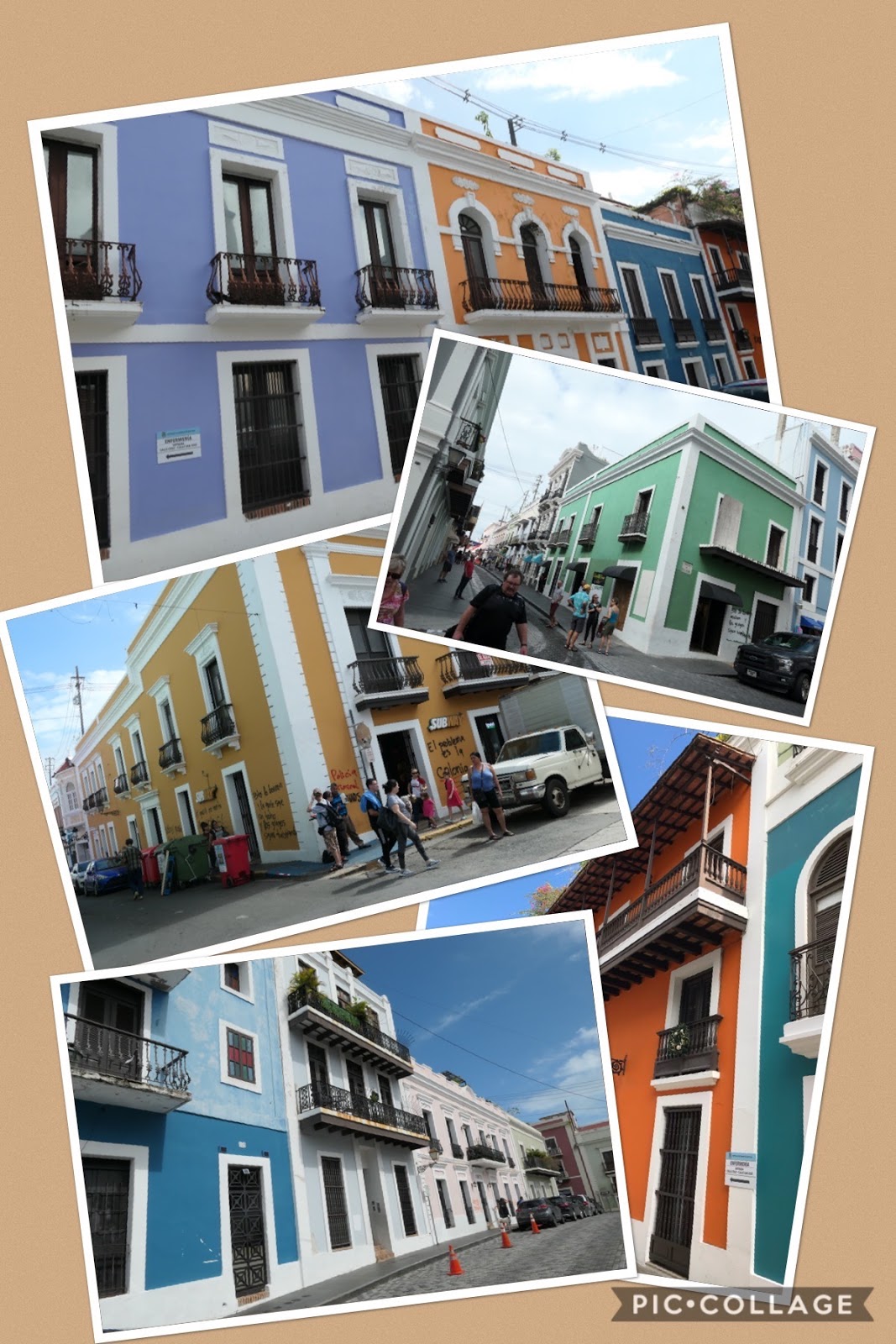
The perfect berth for today, just a few minutes walk from Old San Juan.  So once the breakfast time drizzle cleared up it’s ashore for a leisurely stroll through the narrow streets.  Certainly they seem to like their colours here.


Quite a few signs of the recent earthquakes, mostly minor.  Very hot and rather humid but an easy pace kept us going.  Much graffiti on many buildings, not quite sure but got the impression that the police and the US authorities were not loved, maybe in reference to a recently found  warehouse full of aid for the hurricane of 3 years ago had been found to be  untouched and had been liberated by the population!


A welcome aboard Queen Victoria and back into the air conditioning and a chance for a cold drink.  Time for a few more minutes out in the sun for some more acclimatisation.  An opportunity today while the ship’s still quiet for formal afternoon tea in the Queens Room, to be served by the white gloved and jacketed waiters on the best crockery and the best silverware.

Sailaway at dusk with views of the Morro Fort which protects the harbour mouth.